



Janela da Alma (2001)
Genre: Documentary
Duration: 73 minuten
Alternative title: Window of the Soul
Country:
Brazil
Directed by: João Jardim and Walter Carvalho
Stars: José Saramago, Wim Wenders and Oliver Sacks
IMDb score:
 7,7 (724)
Releasedate: 20 October 2001
This movie is not available on US streaming services.

Janela da Alma plot
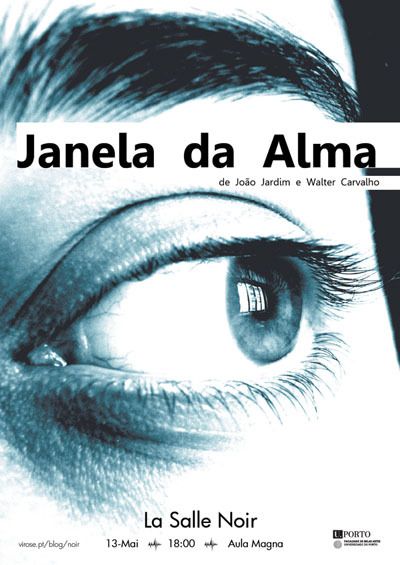
Portuguese writer and Nobel laureate José Saramago once sat on the top balcony of the opera, where he had a good view of the chandelier that looked so dazzling from the ground. From the balcony he suddenly saw the true form of the object, complete with cobwebs and dirt. A life lesson he would never forget, he tells directors João Jardim and Walter Carvalho, who took the subjective experience of seeing as the subject in their documentary. Wim Wenders also explains his obsession with seeing and blindness once again: he makes a plea for glasses, which frame the world in contrast to contact lenses. Wenders sees an advantage in this limitation. Neurologist Oliver Sacks underlines the importance of imagination: you can tell yourself that you can see a magnetic field above an object with 'the eyes of the mind'. Furthermore, Agnès Varda, Hanna Schygulla and a number of Brazilian writers, poets and musicians talk about their personal experiences with blind and partially sighted people. For example, a blind bus passenger knows exactly where he is on the route at any given moment, because he knows the map of the neighborhood and all the bumps and bends of the road by heart. Blindness is also relative: criticism can be heard of the bombardment of images that is poured out on the contemporary viewer and that leaves us beaten, 'blind'. '
Actors and actresses

Self

Self

Self

Self
Self

Self

Self

Self
Self
Self (Gabriel's Mother)







Corporate & Media
Realtimes Network
 Innovatieweg 20C
7007 CD, Doetinchem, Netherlands
+31(315)-764002
