


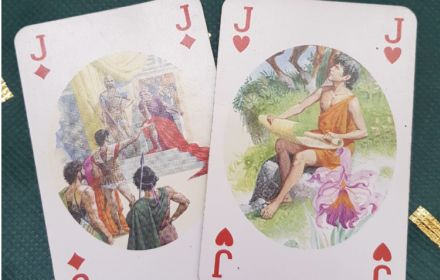
Have you ever noticed how, if a movie has a poker game, the good guys will always excel at it? Maybe they’ve never even played before... yet they’ll sit down at a table, and suddenly, they’ve got every instinct needed to read their opponents, play their cards well, and win the hand. Obviously, that wouldn’t happen in real life; poker’s a complex game that takes years to master. In movies, though, it kind of has to unfold this way, at least most of the time.
But why?


We Admire Poker Qualities
First of all, certain qualities are required to be a whizz at poker. If you’ve ever played poker online, you’ll know exactly what we’re talking about here. It’s not just about looking at an opponent’s face and deciding whether they’re holding a good hand or not; it’s about reading the nuances of a slight hesitation, a raised bet, a bluff that doesn’t quite make sense. Indeed, playing poker online requires you to manage much more subtle signals, making it potentially even more satisfying than an in-person game.
What’s notable, though, is that those qualities tend to be ones that we admire as a society. Reading people is particularly viewed as a great skill to have, especially the kind we see on the screen, where the character hardly has to look at their opponent to guess what their cards are!
That’s one of the major reasons that directors make their “good guys” so great at poker. They want us to see them as intelligent, balanced, sharp individuals, capable of outsmarting and outwitting their opponents – and poker is a remarkably good way to demonstrate that. You see this in TV shows too; take a show like Leverage, and you know that the Mastermind Nathan Ford is going to be great at poker, even if he generally has some additional trick up his sleeve to ensure he wins.
Other poker skills are also seen as admirable. The ability to adapt to the unexpected and handle challenging outcomes without being too ruffled – that's another key quality at the table, and one that poker can be used to demonstrate. If a character faces a difficult twist and manages to overcome it with aplomb, that’s perfect for demonstrating just how cool and centered they really are.
And the ability to keep one’s own thoughts and feelings hidden – that's seen as another highly desirable quality. The phrase “poker face” is ubiquitous and definitely coveted, and if a director wants to show his characters are capable of “playing close to the chest” (look, another poker phrase adopted into common language!), this is one of the fastest and neatest ways to do it.
So, the qualities poker can show:
-
Astute people reading skills
-
Caution
-
Boldness (yes, both of these, depending on the scene)
-
Adaptability
-
Courage
-
Good decision-making
-
Cleverness
-
Wiliness
-
Discipline
-
Patience
-
Emotional intelligence
-
Emotional mastery
-
Mental strength
-
Instinct
Who wouldn’t want to demonstrate those qualities in the heroes of their stories? Establishing a character’s intelligence in film can be challenging, and poker aptitude is one effective way to do it.
A Loss Feels Unsatisfying
That’s not the only element, though. While in reality, losing a poker game is just part of playing, in a movie, it’s not usually that simple. The poker game represents something bigger – it represents the character’s ability to win in the world they’re operating within. If you’re not quite sure what we mean there, Doyle Brunson’s perspective might help. 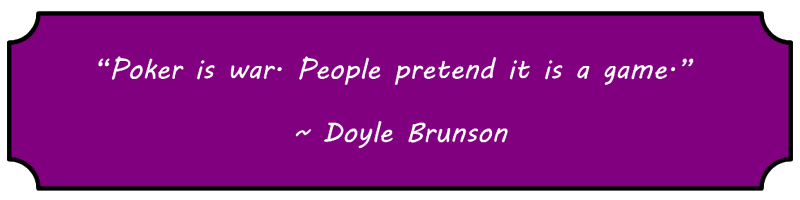 A poker game usually represents a key moment in a movie or show, a point at which the main character needs to exert control over their surroundings. Sure, sometimes they’ll lose as a part of driving the plot, but more often, they need to be shown as a winner who can dictate how events unfold. We’re rooting for them; we want them to win! If they don’t, the whole game tends to feel a bit... underwhelming. Flat. Disappointing.
Even when they do lose, it’s often because their opponent cheated in some way. This is a pretty effective twist from the filmmaking perspective because it allows the plot to develop with the main character losing, gives us another reason to hate the antagonists, and doesn’t undermine the image of the main character as a talented poker player.
Of course, in games where everything is fair, we still have to believe that the protagonist might lose; we need moments where the table seems to go against them, where they seem to struggle. Poker represents the bigger struggle within the film; if they win too easily, the audience will lose interest and stop investing in them.
That’s why directors have to create a balance at the table where their opponents are also skilled, daring, and good at reading people – just not as good as the main character. Doing so ensures the main character looks especially skilled by contrast, maximizing the audience’s investment and driving up the stakes.
All in all, then, there are multiple reasons why a main character in a movie almost has to be good at poker, and this device has remained effective across the years – it's not likely to go away any time soon!


Comments (0)