


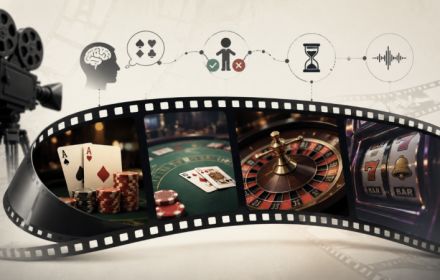
Casino scenes in movies fail when the game is just there as decoration. They work when the viewer can feel what the character should be feeling in that game. A good table scene does not require the viewer to know all the rules of the game in question, just to understand what the character’s emotions are. It gives the game a dramatic job: expose nerve, patience, status, calculation, bluffing, or panic through actions the camera can read.
That is why the format matters. A 2015 Frontiers in Psychology model of tension and suspense links suspense to conflict, instability, uncertainty, prediction, and the desire for resolution. Casino scenes are built from those ingredients. Poker keeps information hidden. Blackjack makes a choice visible. Roulette turns attention toward one tense moment. Slots give a director movement, sound, and quick reactions.


The Game Creates the Pressure
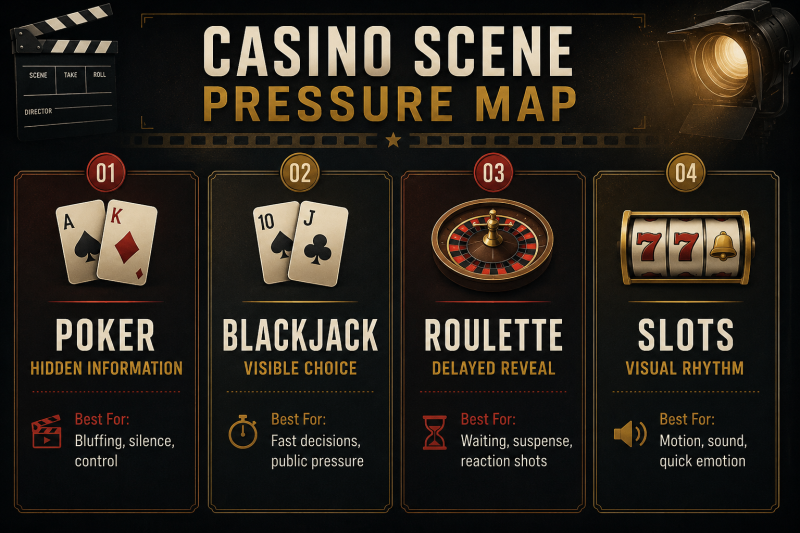
A filmmaker choosing a casino game is also choosing the type of pressure the scene can carry. Poker suits private calculation because bluffing is such an important aspect of that game. Blackjack suits fast public judgment because the player has to make a decision while the table watches. Roulette suits delayed release because the ball moving toward a number creates tension. Slots suit rhythm because the screen can move between lights, sound, and expression without stopping for explanation.
If you want a clear look at how those formats sit beside one another outside a film scene, a site providing online casino games for real money will often have a wide variety of slots, table games, live dealer play, specialty games, and video poker in one place. That comparison helps a film fan notice why each game changes pacing, body language, and audience attention in a different way.
A recent Cafe Casino breakdown of Las Vegas trip costs can also give some perspective on what a fictional character would likely encounter during a scene set in a casino. Obviously, it depends a little on what the plot is and why they are in a casino in the film, but getting a rough idea of how much they would likely be spending on accommodations and what their overall budget looks like can help ground the scene for many viewers.
Poker is the obvious cinematic choice when the story needs hidden information. The cards matter, but the scene usually focuses on everything around them: eye contact, speech, pauses, chip movement, and the strange discipline of not reacting too soon. A player can be powerful because they say nothing. Another can look exposed because they say too much.
Movie writers love poker because it turns stillness into behavior. A small delay can suggest calculation. A casual smile can become a challenge. A character who looks calm may be performing calmness for the table. That difference matters because poker scenes often place several performances inside one frame. Each player is watching the others while trying to control how they are perceived themselves.
Weak poker scenes treat the table as a stylish backdrop. Strong ones make the hand alter the social balance. A character gains authority, loses composure, misreads someone, or reveals a flaw that was already present but not yet visible. The game gives that flaw a clean shape.
Blackjack and Roulette Make Suspense Easier to Read
Blackjack gives cinema a more direct form of pressure. The viewer does not need to know every fine point to understand the shape of the moment. What is important is that they see the player making a choice. The scene can cut between the cards, the dealer, the player, and the people watching, but the act of making a choice is the most important aspect. That clarity is useful when a film wants tension without slowing down for exposition.
Roulette works from the opposite direction. The choice is made early on, but the important aspect is the outcome. Players watch the ball to see where it lands, and the tension rises as the wheel starts to slow. It is a simple structure, which is why directors can stretch it out without losing their audience. Everyone understands that the motion is leading to a reveal.
Slots bring another kind of screen energy. They can show speed, repetition, distraction, excitement, or boredom through rhythm, rather than dialogue. A slot scene does not need heavy explanation if the point is the character’s state of mind. The action is immediate, and the response is visible.
The Scene Has to Change What We Know
The best casino scenes are not really about whether a character understands a game. They are about what the game reveals under pressure. A disciplined character may expose impatience. A reckless character may suddenly show focus. A confident person may lose the room before losing the hand. A quiet observer may turn out to be the only one reading the table correctly.
This is why accuracy alone is not enough. A technically tidy scene can still feel flat if nothing changes between the first shot and the last. The viewer needs a shift: in status, mood, knowledge, power, or self-control. The game gives the scene rules, but the character gives it meaning.
Casino scenes remain memorable when the audience can track both levels at once: the visible action and the private calculation behind it. The result matters less than the human response it exposes. That response can feel sharper in a crowded theater, where viewers react beside other viewers, as noted in this research on shared filmic experience.


Comments (0)