


Look at this meme circulating on social media:


This is Dwayne Johnson, who has become a meme in a casino gaming context. This is the same actor who starred in Walking Tall in 2004, where a casino was central to the plot. In other words, casinos and movies keep having a honeymoon relationship.
It is not a secret that the narrative of Vegas nights and casino glare has been close to several iconic directors, and they really did a great job producing those movies, the ones we will be talking about below. But this time, the angle is different: how much money have casino scenes brought to the movie industry?
From Felt Tables to Phone Screens
For a long time, casino scenes worked mainly as travel fantasy. Viewers were invited into a world of polished floors, evening wear, glass, smoke, and silent pressure. The attraction was distance.
The audience watched a place that felt rare and slightly removed from everyday life. That helped make casino films glamorous, but it also kept the experience somewhat external. Many viewers admired the room more than the game inside it.
How online poker changed what audiences focused on
The rise of online casino sites changed that relationship, especially through poker online, which is one of the most played games today. Once the game moved onto home computers and later onto phones, public interest shifted from the building to the decision itself. The key appeal became less about entering a grand venue and more about reading timing, pacing, risk, and pattern.
Viewers began to understand what a pause means, what a raise signals, and why one hand can change the tone of a whole scene. That made poker scenes in film easier to read and more satisfying to watch.
Digital play widened the audience for casino storytelling
This change also widened the audience. Land-based casinos had always offered atmosphere and occasion, but digital play made card culture more portable and more regular. People could follow the flow of a table without making a trip.
They could learn the rhythm of a hand through repetition. In simple terms, the culture became less tied to a destination and more tied to habit, curiosity, and screen-based attention. That mattered for movies because it created viewers who arrived already fluent in the emotional beats of casino storytelling.

The demand in online poker gaming has been increasing, and so is its influence on public opinion and entertainment in general about modern gambling.
Source: Here
In that sense, poker is central to the wider theme of casino money in film. It helped turn casino drama into something more accessible and more exportable. Filmmakers gained an audience that could appreciate long table scenes, subtle reactions, and slow-burn tension. The result was a stronger bridge between classic casino fantasy and modern screen culture.
That bridge did not replace the old appeal of land-based casinos, but rather expanded it, and that expansion made casino-centered storytelling more valuable to the movie business.
Box Office Results Show the Commercial Pull
It is hard to know the exact total for the whole industry, but a few major casino-related movies already show how much money these stories can make.
|
Film |
Worldwide box office |
Commercial meaning |
|
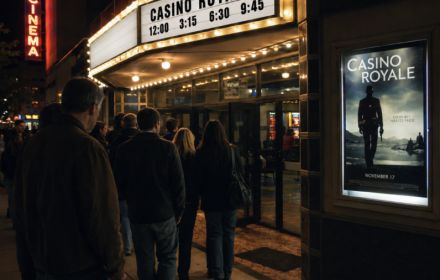
Casino Royale(2006) |
$594.4 million |
Showed that casino tension could help relaunch a major action franchise with premium appeal |
|
Ocean’s Eleven(2001) |
$450.7 million |
Proved the casino setting could carry a glossy ensemble hit with wide mainstream reach |
|
21 (2008) |
$159.8 million |
Confirmed that casino strategy and style could sell beyond franchise filmmaking |
What links these films is efficiency. A casino setting gives a movie clear stakes before a character says much at all. The room already suggests money, risk, timing, and status. That saves storytelling time and strengthens trailers, posters, and word of mouth. It also helps across borders. Viewers in very different markets can read a card table, a vault, a countdown, or a stack of chips without extra explanation.
That is why casino portrayal has delivered more than visual polish. It has given the industry a dependable commercial framework. When it works, it sharpens character, improves marketing, and raises the sense of event around a release.
Why the Casino Image Keeps Paying After Opening Weekend
The money story does not end with one successful release. Casino imagery is highly reusable, and that is where its value grows. The Ocean’s series is a clear example. Across its four released films, the franchise has reached about $1.42 billion worldwide.
That kind of return suggests that the casino setting is more than a one-film hook. It is a repeatable screen language that can carry sequels, spin-offs, and long catalog life.
Casino scenes become brand markers for bigger franchises
The same logic helps explain why casino-centered scenes often become identity markers for larger brands. As Henry K. Miller wrote for the BFI, “Skyfall, without breaking the new cycle begun by Casino Royale, is also a pivotal episode in the 60-year cross-media, multi-author odyssey.”
That line captures something important about casino portrayal in film. A strong casino sequence can refresh a franchise’s image, give it prestige, and shape how audiences remember the wider series. In business terms, that means value extends beyond one opening weekend into later entries, library viewing, and brand memory.
Casino-driven hits feed the wider creative economy
There is also a wider industry effect. The Motion Picture Association reported in February 2026 that the American film and television industry supports 2.01 million jobs, pays $202 billion in wages, and includes more than 162,000 businesses.
Casino-driven hits feed that larger system through production crews, costumes, music, editing, visual design, marketing, and exhibition. Even when the exact “casino share” cannot be separated out on a balance sheet, the revenue from these films clearly moves through a large creative economy.


Comments (0)